

At the South Pole, the IceCube Neutrino Observatory, embedded in a cubic kilometer of Antarctic ice, searches for weakly interacting particles called neutrinos that are able to travel undisturbed through the cosmos. Earlier this year, scientists at the Wisconsin IceCube Particle Astrophysics Center (WIPAC) reported, for the first time, an interesting feature or “break” in an otherwise smooth distribution of all astrophysical neutrinos in the universe.

“The high-energy neutrino spectrum was previously found to be consistent with a power law—a simple, featureless energy distribution expected from many standard particle acceleration processes,” says Ke Fang, an associate professor of physics at UW–Madison. “Because such a break is not predicted by standard acceleration theories, it provides unique insight into the production mechanisms of these neutrinos.”
Now, in a study submitted to The Astrophysical Journal Letters, Fang and other WIPAC researchers investigated the origin of this distinct feature in the IceCube neutrino spectrum. Their analysis suggests that the feature arises from proton interactions with X-ray radiation in environments such as those surrounding supermassive black holes.
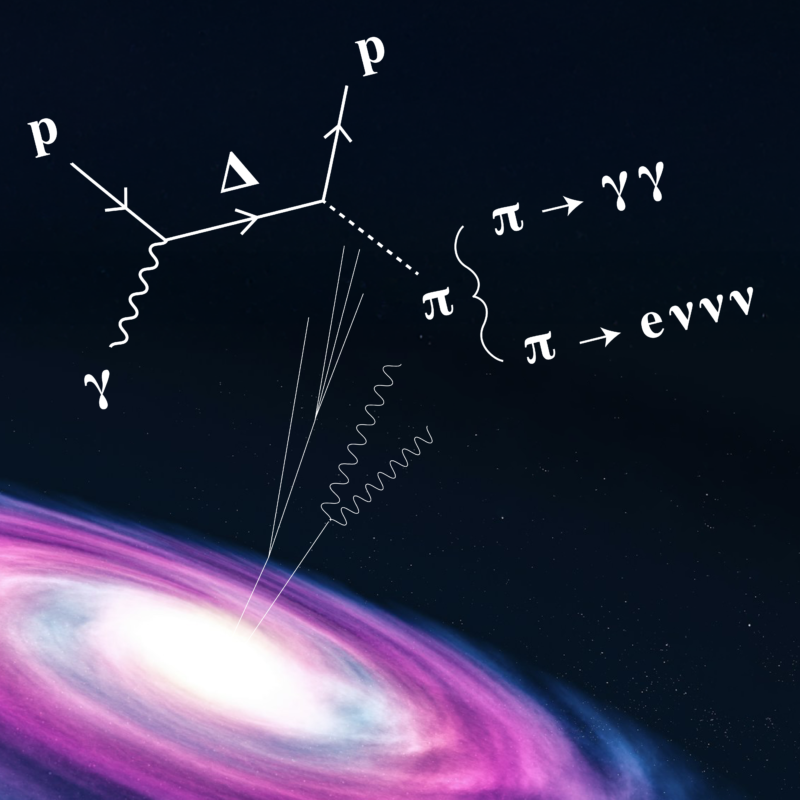
“It turns out when protons hit light, they can turn into other subatomic particles by creating a short-lived particle called a delta baryon,” explains Dan Hooper, a professor of physics at UW–Madison and WIPAC director. “This leads to a feature that is similar to the spectral break observed by IceCube.”
For the analysis, the researchers performed calculations of the neutrino spectrum resulting from proton collisions with low-energy photons. They then compared those results to the spectrum reported by IceCube.

“We explored the multimessenger consequences of the neutrino spectral break at 30 TeV, notably showing that a soft X-ray target with an energy of ~0.3 keV is needed to produce such a diffuse spectrum,” says Arifa Khatee Zathul, a PhD graduate student at UW–Madison who performed the work. “Furthermore, we also do not rule out the possibility of neutrino sources being transparent to high-energy gamma rays that are coproduced with the neutrinos.”
With future measurements by IceCube and IceCube-Gen2, the proposed extension of IceCube, the researchers hope to clarify the shape of the neutrino spectrum to ultimately pinpoint the origin of high-energy neutrinos.
+ info “The Delta Resonance in the Neutrino Sky,” Arifa Khatee Zathul, Ke Fang, Francis Halzen, and Dan Hooper., Submitted to The Astrophysical Journal Letters, arXiv