Last month, the U.S. National Science Foundation renewed a cooperative agreement with the University of Wisconsin–Madison to manage and operate the NSF IceCube Neutrino Observatory. The five-year, $53 million cooperative agreement entails the continued operation and maintenance of IceCube for the period 2026-2031.
“The generous funding will allow us to further improve the performance of the instrumentation and extend the string of discoveries made with IceCube over the last decade,” says Francis Halzen, the Vilas Research Professor and Gregory Breit Professor at the University Wisconsin–Madison and IceCube’s principal investigator.
Funding for the operation and maintenance of IceCube, an NSF major facility, comes from the NSF Office of Polar Programs, in coordination with the agency’s Office of Research Infrastructure. Through the Office of Polar Programs, NSF manages the U.S. Antarctic Program, which supports researchers throughout the country and provides infrastructure to support those researchers in the field.
“This renewed investment in the NSF IceCube Neutrino Observatory will enable discoveries across a broad range of disciplines, propel progress in data-intensive science, and strengthen the nation’s research enterprise in Antarctica,” said Marion Dierickx, Program Director, Antarctic Astrophysics and Geospace Sciences.
IceCube uses one cubic kilometer of Antarctic ice to detect nearly massless particles called neutrinos that travel undisturbed through outer space. Because they rarely interact with matter, neutrinos can provide a lens into otherwise obscured extreme cosmic environments, carrying valuable information about their sources. Thus far, IceCube has discovered astrophysical neutrinos, identified supermassive black holes of active galaxies as the sites where high-energy neutrinos and cosmic rays originate, and observed neutrinos from our own Milky Way galaxy. Most recently, the IceCube Upgrade was successfully deployed, marking the first significant expansion of IceCube since its completion 15 years ago.
With the completion of the Upgrade, IceCube will operate more than 5,500 optical modules installed in 91 boreholes drilled into the Antarctic ice sheet. Together, the new sensors and the 58 new special and calibration devices will enable more precise measurements of neutrino properties than ever before. Scientists will be able to better characterize the surrounding ice, leading to enhanced reconstruction of neutrinos and a reanalysis of 15 years of archived data. The Upgrade will also improve the scientists’ ability to detect neutrinos from distant cosmic sources. In addition, IceCube will continue to study deep glacial environments and expand seismic monitoring from one of the quietest locations on Earth.
“Operating the new Upgrade sensors and calibration devices is an exciting challenge,” says John Kelley, IceCube’s director of operations. “Integrating them into the existing detector is going well, and we are looking forward to taking physics data later this year.”

The IceCube Collaboration, with over 450 scientists in 58 institutions from around the world, runs an extensive scientific program that has established the foundations of neutrino astronomy. The NSF cooperative agreement includes subawards to six U.S. institutions that contribute to core activities of the operation and maintenance of IceCube: the Lawrence Berkeley National Laboratory supports distributed computing and the long-term data archive at the National Energy Research Scientific Computing Center; the University of Delaware is the principal institution for the maintenance of IceTop, the surface component of IceCube; the University of Maryland coordinates IceCube software, including online filtering and simulation; the University of Alabama at Tuscaloosa leads the detector calibration efforts; Michigan State University is a main contributor to IceCube software and simulation production; and the University of Utah is responsible for the operation of new calibration devices in the Upgrade.
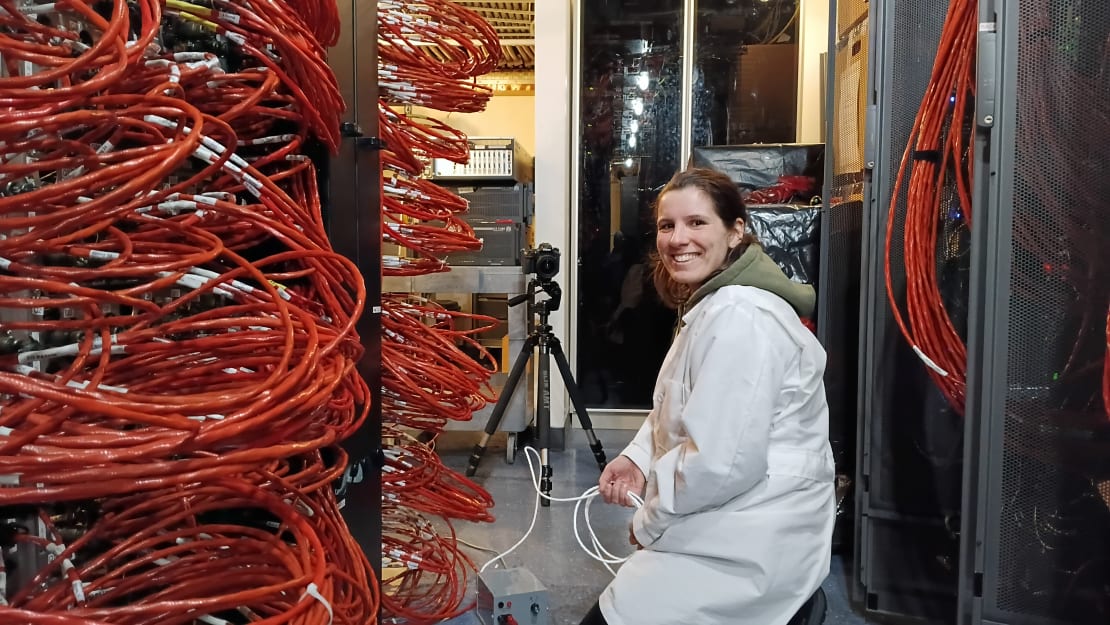
The next five years will bring several major changes to IceCube. Processing and analyzing data from the Upgrade will require advanced artificial intelligence and machine learning methods, necessitating new software development. On the maintenance side, collaborators will upgrade hardware, both at the South Pole and data facilities in the Northern Hemisphere, including replacement of IceCube’s 20-year-old surface data acquisition electronics.
“With the newly installed Upgrade, this funding ensures that IceCube remains at the forefront of exploring the neutrino sky and positions us to make new discoveries in the years ahead,” says Erin O’Sullivan, an associate professor of physics at Uppsala University and IceCube spokesperson.