
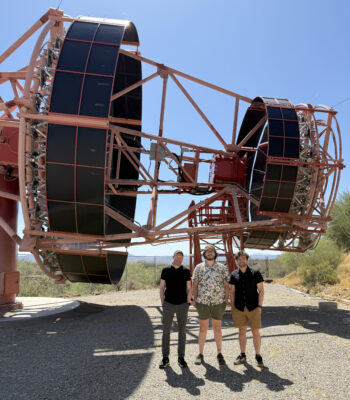
An upgrade of the prototype Schwarzschild-Couder Telescope (pSCT), located at the Fred Lawrence Whipple Observatory in Arizona, is well underway. In spring 2026, the first 22 camera modules, featuring 1408 channels, were installed and commissioned. The upgrade and commissioning of the camera is being led by University of Wisconsin–Madison (UW–Madison) physics professor Justin Vandenbroucke and his research team. According to Vandenbroucke, “After years of work designing, producing, and testing the new instrumentation, it has been a thrilling year of milestones for the pSCT camera upgrade: first module installation, first light, first muon rings, and first source detection. I’m proud of both our UW contributions and of the entire pSCT team across the country and across the world.”
The upgraded modules have new electronics with lower noise and improved sensors, providing clean, high-resolution images of gamma-ray and cosmic-ray induced air showers. They are installed at the edge of the field of view, enabling characterization of the optical and gamma-ray performance up to 4° off-axis. Shower images include sharp rings produced by muons that reach ground level, which validate the trigger, readout, and optical imaging resolution.
In April 2026, the pSCT completed an observing campaign of the blazar Markarian 421, a galaxy with a powerful black hole at its center, simultaneously with the Very Energetic Radiation Imaging Telescope Array System (VERITAS) and the Imaging X-ray Polarimetry Explorer. As presented by UW–Madison PhD student Luca Riitano at the IceCube Particle Astrophysics Symposium in October, this campaign resulted in detection of Markarian 421 at 7.8 sigma significance by the pSCT alone using 2.75 hours of data. The source was located approximately 2.7° off-axis.
“This observing campaign and analysis not only serve as validation of the upgraded camera and further evidence of the SCT design’s efficacy but demonstrate one of the key advantages that the SCT has over single-mirror imaging atmospheric Cherenkov telescopes—the improved image quality of its off-axis observations, even far from the center of the camera,” says Riitano, who has played a leading role in camera module performance characterization, module installation, and data analysis.
The Schwarzschild-Couder Telescope is a dual-mirrored version of the Medium-Sized Telescope designed for the Cherenkov Telescope Array Observatory (CTAO). The pSCT is a prototype of this concept, located next to VERITAS. The pSCT is designed to detect very high-energy gamma rays in the 100 GeV to 100 TeV energy range. These gamma rays originate in cosmic sources such as pulsars and fast jets from giant black holes in distant galaxies.
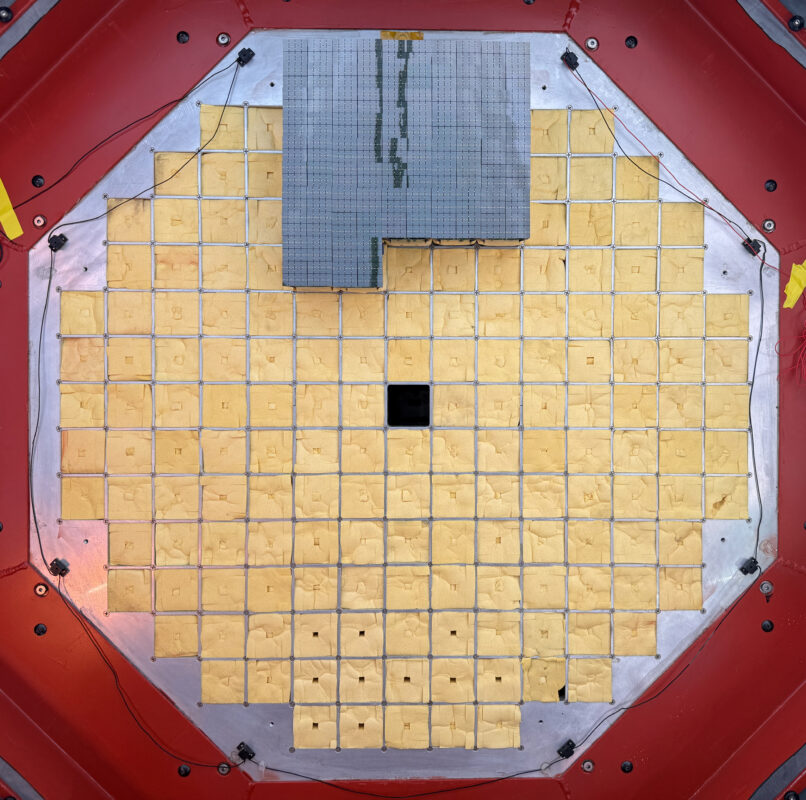
Vandenbroucke’s UW team has worked on the construction and integration of the SCT camera for the past 13 years. Assembly and testing of the original camera was completed in Madison in spring 2018, followed by installation of the camera as well as inauguration of the telescope and first light in 2019, detection of the Crab Nebula in 2020, and then camera performance characterization in 2022.
“This installation and observing campaign was a heroic effort by the whole team. The ability to go from no pixels in the camera to first light in four days, and then science quality data one week after that, required us to get so many different pieces right,” says Zach Curtis-Ginsberg, a UW–Madison PhD student who lived at the observatory for three months in spring 2026 in order to lead installation, system commissioning, and observing with the pSCT. “This was an awesome opportunity, and I’m looking forward to what we can do with the entire camera.”
In addition to prototyping telescope technology for potential future SCTs to be constructed at the southern CTAO site in Paranal, Chile, the pSCT provides a development platform for other CTAO technologies. The CTAO Small-Sized Telescopes (SSTs) use optics and camera electronics very similar to the SCT and have been developed in collaboration with SCT scientists. CTAO scientists at UW–Madison and Washington University in St. Louis are collaborating with international partners to build cameras for 10 Small-Sized Telescopes at CTAO-South.
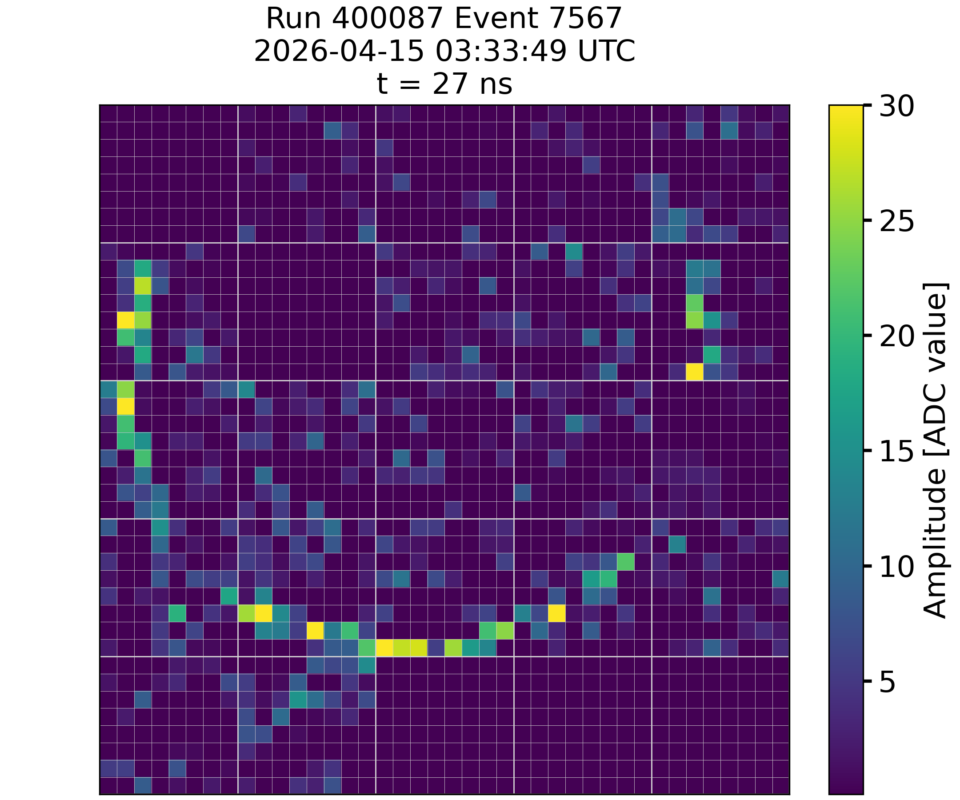
Example image of a ring due to a muon that reached ground level. The image shows a single frame (1 ns duration) from the recorded movie of the air shower development. Credit: SCT Collaboration.
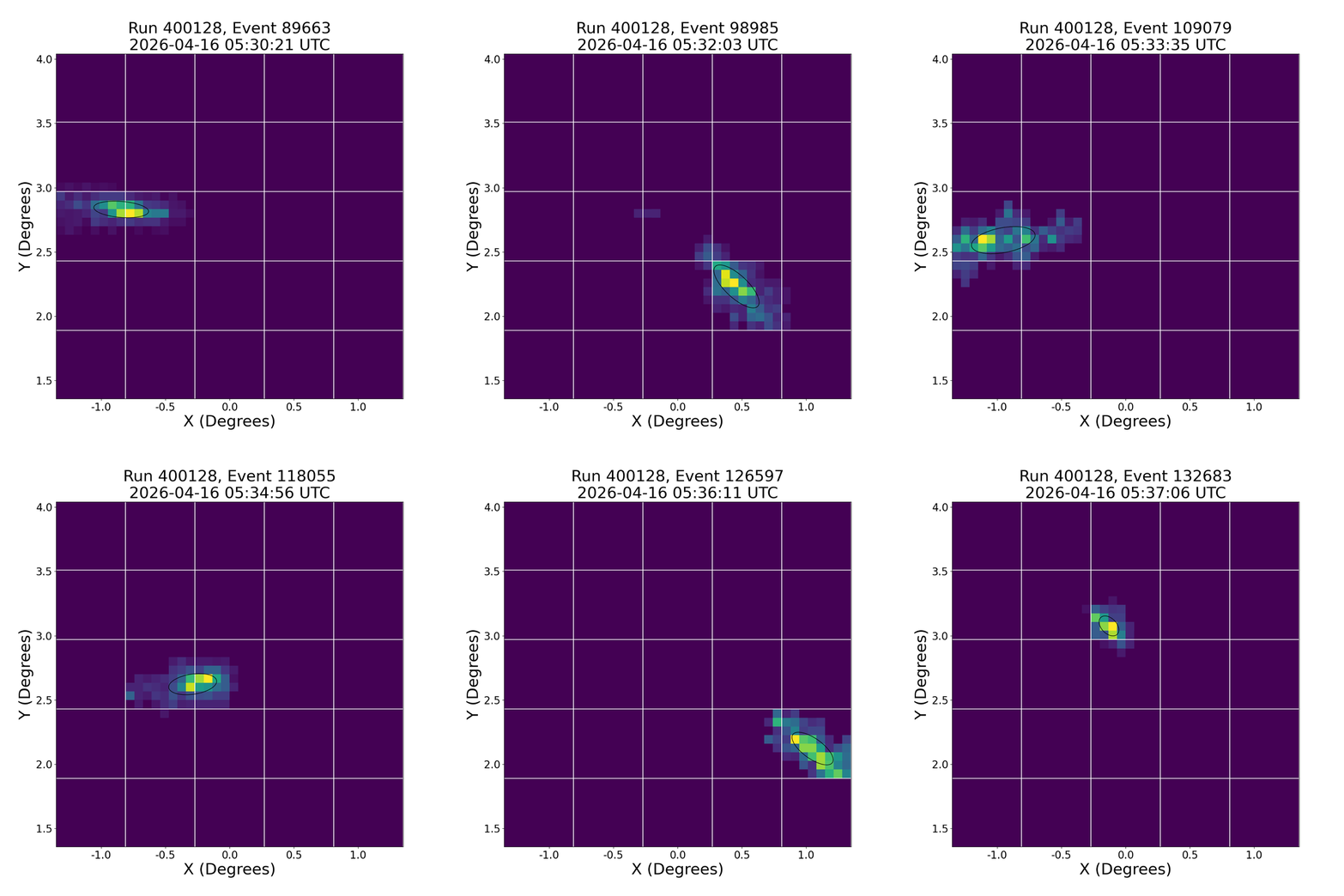
System improvements have been underway since the spring and the camera is expected to be fully instrumented with 177 upgraded modules in 2027. The fully upgraded camera will feature over eleven thousand pixels across an 8° diameter field of view. The pSCT camera upgrade is funded by the U.S. National Science Foundation along with international partners in Italy, Germany, and Japan.
For more, please visit related CTAO news article.