
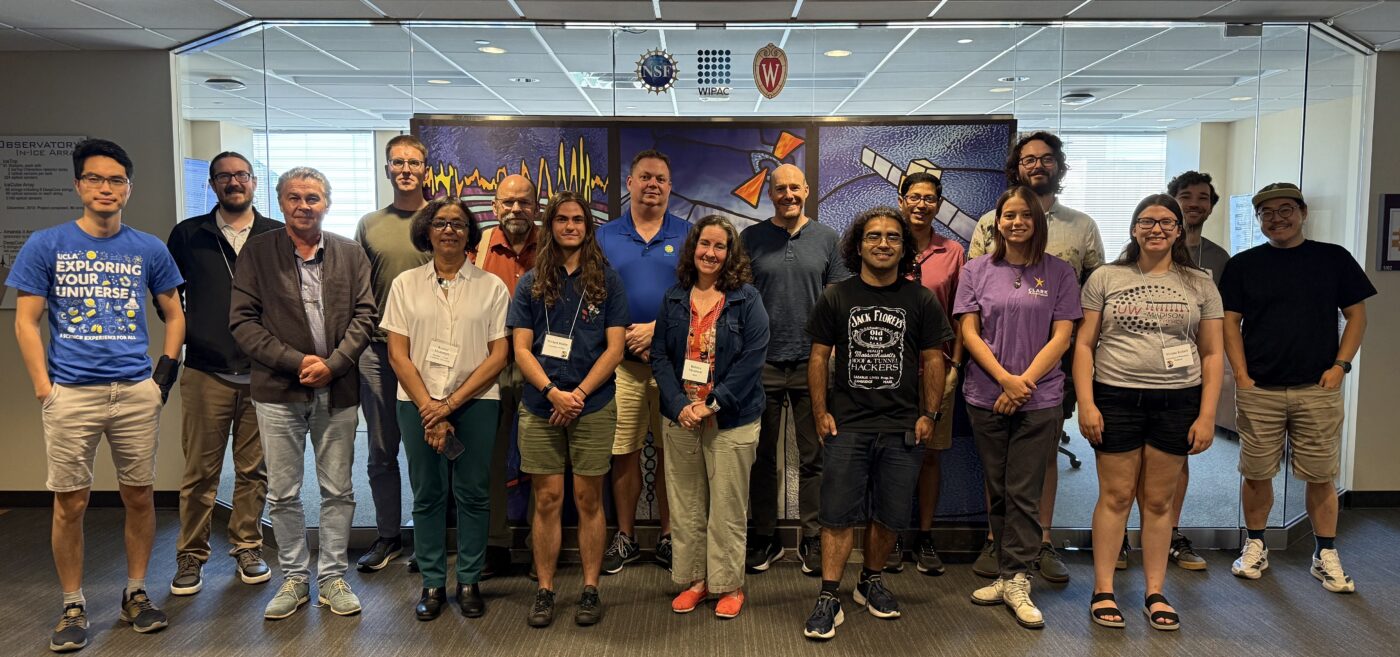
Between July 13 and 15, the Wisconsin IceCube Particle Astrophysics Center (WIPAC) hosted members of the Cherenkov Telescope Array Observatory (CTAO)-US/Schwarzschild-Couder Telescope (SCT) Collaboration for its 2026 summer meeting. The SCT, a medium-sized telescope for CTAO, will be able to detect gamma rays from cosmic sources such as pulsars and supermassive black holes in order to uncover the origins of high-energy cosmic rays. The collaboration is currently busy upgrading the camera of the prototype SCT (pSCT) at the Fred Lawrence Whipple Observatory in Arizona.
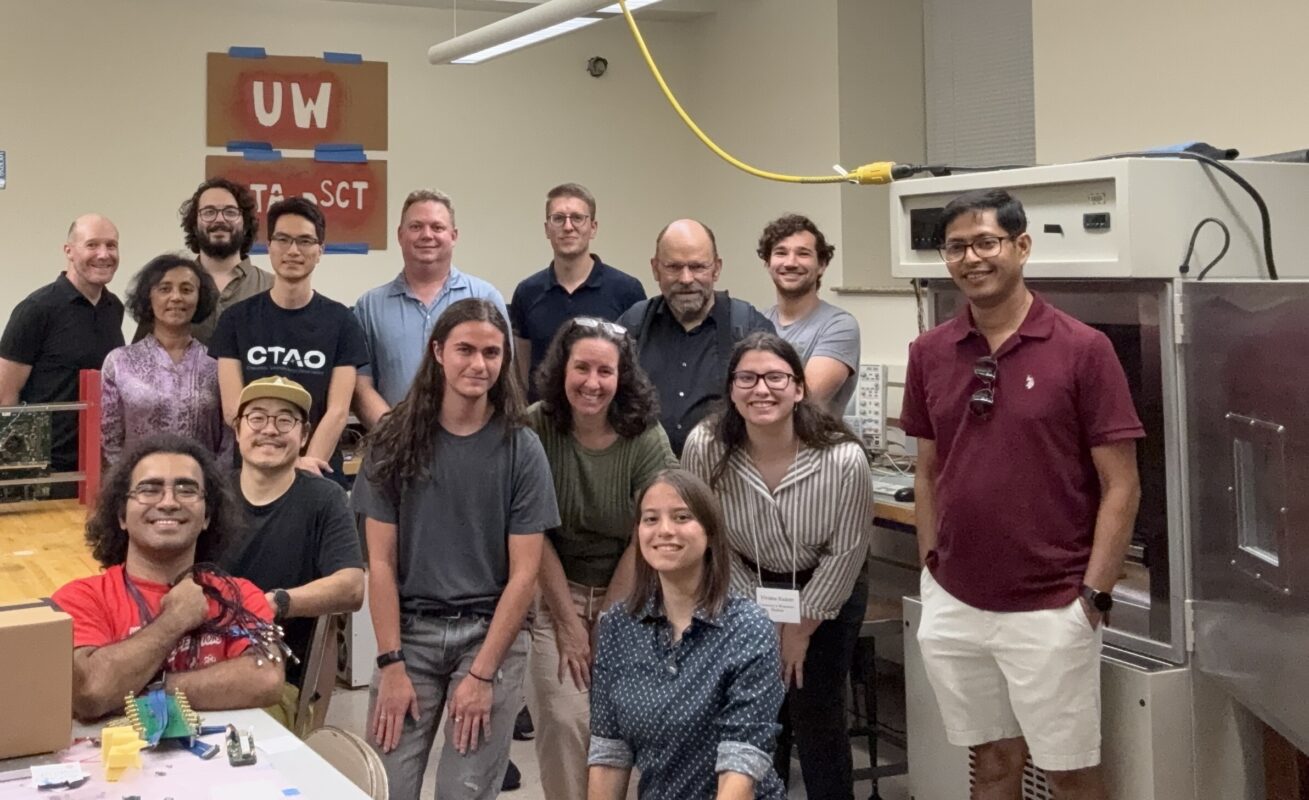
The two-and-a-half-day meeting was packed with talks covering topics such as software and computing, integration and analysis of the camera, simulations, and updates on the CTAO-US project. A highlight of the meeting was a visit to the lab where module testing and system integration is currently taking place. Led by University of Wisconsin–Madison professor Justin Vandenbroucke, the team has worked on the construction and integration of the SCT camera for the last 13 years. With collaborators at Washington University in St. Louis, they were recently awarded a $3.9 million grant from the U.S. National Science Foundation to build and install cameras for the Small-Sized Telescopes (SSTs) located at the CTAO-South site.
“This is an exciting year for the pSCT, with new instrumentation being commissioned on the telescope, fresh data to analyze, and many additional sensors and electronics soon to be tested and integrated in the lab before being installed on the telescope,” says Vandenbroucke. “It was great to spend several days discussing our work in progress and planning the science we will do with CTAO.”